Unlocking E-commerce Success: The Ultimate Guide to the Best CRM Systems
In the fast-paced world of e-commerce, staying ahead of the curve is not just an advantage; it’s a necessity. With countless online stores vying for customer attention, building strong relationships and providing exceptional experiences are crucial for survival and growth. That’s where a Customer Relationship Management (CRM) system steps in – your digital ally in the quest for e-commerce triumph. This comprehensive guide delves into the world of CRM for e-commerce, exploring its importance, benefits, and, most importantly, the best CRM systems available to help you thrive.
Why CRM Matters for E-commerce
Before diving into the specifics, let’s understand why a CRM is indispensable for e-commerce businesses. Think of your customers as the lifeblood of your operation. Without them, your business simply wouldn’t exist. A CRM system acts as the central nervous system, collecting, organizing, and analyzing all the vital information about your customers. This includes their purchase history, browsing behavior, communication preferences, and more. This wealth of data allows you to:
- Personalize the Customer Experience: Tailor your interactions, offers, and product recommendations to individual customer preferences.
- Improve Customer Service: Provide faster, more efficient support by having all customer information readily available.
- Boost Sales and Revenue: Identify upselling and cross-selling opportunities, nurture leads, and close deals more effectively.
- Enhance Marketing Campaigns: Target specific customer segments with relevant messaging, improving campaign performance.
- Gain Valuable Insights: Analyze customer data to understand trends, identify pain points, and make data-driven decisions.
In essence, a CRM empowers you to build stronger customer relationships, which translates to increased customer loyalty, repeat purchases, and ultimately, a more profitable e-commerce business.
Key Features to Look for in an E-commerce CRM
Not all CRM systems are created equal. When choosing a CRM for your e-commerce business, it’s essential to consider specific features that cater to the unique needs of online retailers. Here are some key features to prioritize:
1. Seamless E-commerce Integration
This is arguably the most crucial feature. Your CRM should seamlessly integrate with your e-commerce platform (Shopify, WooCommerce, Magento, etc.). This integration allows for:
- Automated Data Synchronization: Customer data, order information, and product details should automatically sync between your e-commerce platform and your CRM.
- Order Tracking and Management: Track orders, manage shipping, and provide real-time updates to customers directly from the CRM.
- Product Catalog Integration: Easily access and manage your product catalog within the CRM for marketing and sales purposes.
2. Contact Management and Segmentation
Effective contact management is the foundation of any CRM. Look for features that allow you to:
- Store and Organize Customer Data: Capture and store comprehensive customer information, including contact details, purchase history, and communication preferences.
- Segment Your Audience: Create customer segments based on various criteria (purchase history, demographics, behavior) for targeted marketing campaigns.
- Lead Scoring: Identify and prioritize potential customers based on their engagement and behavior.
3. Marketing Automation
Marketing automation streamlines your marketing efforts, saving you time and improving campaign effectiveness. Look for features like:
- Email Marketing Automation: Create and automate email campaigns, including welcome emails, abandoned cart recovery emails, and promotional offers.
- Behavior-Based Triggers: Trigger automated actions based on customer behavior, such as website visits, product views, or purchase history.
- Personalized Content: Deliver personalized content and offers based on customer segments and individual preferences.
4. Sales Automation
Sales automation features help your sales team close deals more efficiently. Look for:
- Sales Pipeline Management: Track leads and opportunities through your sales pipeline.
- Task Management and Reminders: Set tasks and reminders for follow-ups and other sales activities.
- Deal Tracking: Monitor the progress of deals and identify potential roadblocks.
5. Customer Service and Support
Providing excellent customer service is crucial for building customer loyalty. Look for features like:
- Help Desk Integration: Integrate your CRM with a help desk system to manage customer inquiries and support tickets.
- Live Chat Integration: Offer real-time support to customers through live chat.
- Knowledge Base: Create a knowledge base with FAQs and helpful articles to empower customers to find answers on their own.
6. Reporting and Analytics
Reporting and analytics provide valuable insights into your customer data and campaign performance. Look for features that allow you to:
- Track Key Metrics: Monitor key performance indicators (KPIs) such as customer acquisition cost, customer lifetime value, and conversion rates.
- Generate Reports: Generate custom reports to analyze your data and gain actionable insights.
- Visualize Data: Use dashboards and visualizations to easily understand your data.
Top CRM Systems for E-commerce: A Detailed Comparison
Now, let’s dive into some of the top CRM systems specifically designed for e-commerce. Each system has its strengths and weaknesses, so consider your specific needs and budget when making your choice.
1. HubSpot CRM
Overview: HubSpot CRM is a popular choice for e-commerce businesses due to its user-friendliness, comprehensive features, and free plan. It offers a robust set of tools for contact management, sales, and marketing automation.
Key Features for E-commerce:
- Free CRM: HubSpot offers a generous free plan that includes contact management, deal tracking, and basic marketing automation.
- E-commerce Integrations: Integrates seamlessly with popular e-commerce platforms like Shopify, WooCommerce, and BigCommerce.
- Marketing Automation: Powerful marketing automation features, including email marketing, lead nurturing, and behavior-based triggers.
- Sales Tools: Sales pipeline management, deal tracking, and sales reporting.
- Customer Service Tools: Help desk integration and live chat functionality.
Pros:
- User-friendly interface.
- Comprehensive features, even in the free plan.
- Excellent e-commerce integrations.
- Strong marketing automation capabilities.
Cons:
- Advanced features require paid plans.
- Can be overwhelming for very small businesses.
2. Salesforce Sales Cloud
Overview: Salesforce Sales Cloud is a leading CRM platform known for its scalability, customization options, and powerful features. It’s a great choice for larger e-commerce businesses with complex needs.
Key Features for E-commerce:
- Highly Customizable: Extensive customization options to tailor the platform to your specific needs.
- Advanced Sales Automation: Sophisticated sales pipeline management, lead scoring, and opportunity management.
- Reporting and Analytics: Robust reporting and analytics capabilities with customizable dashboards.
- AppExchange: Access a vast marketplace of apps and integrations to extend the platform’s functionality.
- E-commerce Integrations: Integrates with various e-commerce platforms through the AppExchange.
Pros:
- Highly scalable and customizable.
- Powerful sales automation features.
- Extensive reporting and analytics capabilities.
- Large ecosystem of apps and integrations.
Cons:
- Can be expensive, especially for small businesses.
- Steep learning curve.
- Implementation can be complex.
3. Zoho CRM
Overview: Zoho CRM is a versatile and affordable CRM system that’s a good fit for businesses of all sizes. It offers a wide range of features, including sales automation, marketing automation, and customer service tools.
Key Features for E-commerce:
- Affordable Pricing: Offers a variety of pricing plans to suit different budgets.
- E-commerce Integrations: Integrates with popular e-commerce platforms like Shopify and WooCommerce.
- Marketing Automation: Includes email marketing automation, lead nurturing, and segmentation.
- Sales Automation: Sales pipeline management, deal tracking, and task management.
- Customer Service Tools: Help desk integration and live chat functionality.
Pros:
- Affordable pricing plans.
- User-friendly interface.
- Comprehensive features for sales, marketing, and customer service.
- Good e-commerce integrations.
Cons:
- Marketing automation features are not as advanced as some competitors.
- Customization options are more limited than Salesforce.
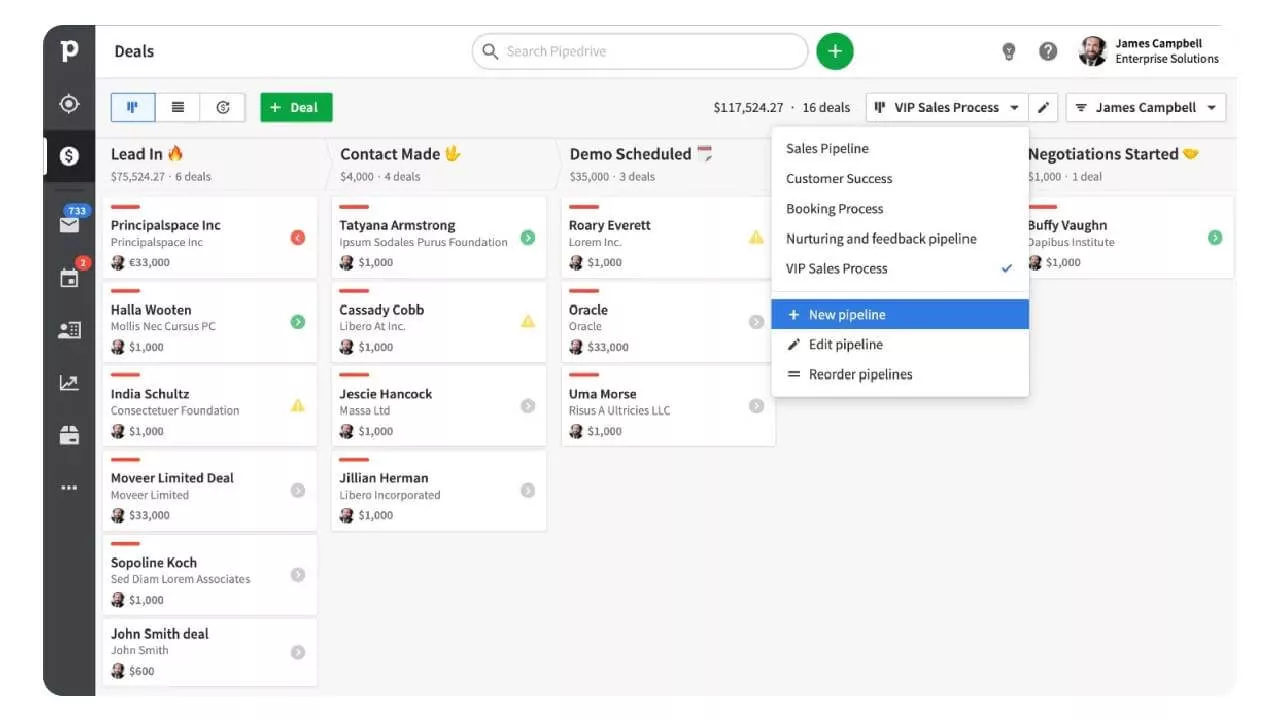
4. Pipedrive
Overview: Pipedrive is a sales-focused CRM system designed to help sales teams manage their pipelines and close deals more effectively. It’s known for its intuitive interface and ease of use.
Key Features for E-commerce:
- Sales Pipeline Management: Visual and intuitive sales pipeline management.
- Deal Tracking: Track deals and monitor their progress through the pipeline.
- Automated Workflows: Automate repetitive tasks and streamline your sales process.
- E-commerce Integrations: Integrates with various e-commerce platforms, including Shopify.
- Reporting and Analytics: Sales performance reports and analytics.
Pros:
- User-friendly interface.
- Focus on sales pipeline management.
- Easy to set up and use.
- Good for small to medium-sized businesses.
Cons:
- Limited marketing automation features.
- Not as feature-rich as some competitors.
5. Agile CRM
Overview: Agile CRM is an all-in-one CRM platform that combines sales, marketing, and customer service features. It’s a good choice for businesses looking for a comprehensive solution at an affordable price.
Key Features for E-commerce:
- All-in-One Platform: Combines sales, marketing, and customer service features.
- E-commerce Integrations: Integrates with popular e-commerce platforms.
- Marketing Automation: Includes email marketing automation, lead nurturing, and social media integration.
- Sales Automation: Sales pipeline management, deal tracking, and task management.
- Customer Service Tools: Help desk integration and live chat functionality.
Pros:
- All-in-one platform with a wide range of features.
- Affordable pricing.
- Good e-commerce integrations.
- User-friendly interface.
Cons:
- Can be overwhelming for very small businesses.
- Marketing automation features are not as advanced as some competitors.
Choosing the Right CRM for Your E-commerce Business
Selecting the right CRM is a critical decision that can significantly impact your e-commerce business’s success. Here’s a step-by-step approach to help you make the right choice:
1. Assess Your Needs
Before you start evaluating CRM systems, take the time to understand your specific needs and goals. Consider these questions:
- What are your current challenges? Are you struggling with customer communication, sales processes, or marketing campaigns?
- What are your goals? Do you want to increase sales, improve customer loyalty, or streamline your operations?
- What features do you need? Make a list of essential features, such as e-commerce integration, marketing automation, and sales pipeline management.
- What is your budget? Determine how much you’re willing to spend on a CRM system.
- What is your team size and technical expertise? Consider the size of your team and their technical skills when choosing a system.
2. Research and Compare CRM Systems
Once you have a clear understanding of your needs, start researching different CRM systems. Use the information in this guide as a starting point, and explore other options as well. Compare the features, pricing, and integrations of each system to determine which ones align with your needs.
3. Consider E-commerce Platform Integration
Ensure that the CRM system you choose integrates seamlessly with your e-commerce platform (Shopify, WooCommerce, Magento, etc.). This integration is crucial for automating data synchronization, tracking orders, and managing your product catalog.
4. Read Reviews and Case Studies
Read reviews and case studies from other e-commerce businesses to get insights into their experiences with different CRM systems. This can help you identify potential pros and cons of each system.
5. Request Demos and Free Trials
Most CRM vendors offer demos and free trials. Take advantage of these opportunities to test the systems and see how they work in practice. This will help you determine if the system is a good fit for your business.
6. Implement and Train Your Team
Once you’ve chosen a CRM system, implement it and train your team on how to use it effectively. Provide ongoing support and training to ensure that your team is able to leverage the system’s features to their full potential.
Maximizing Your CRM Investment
Implementing a CRM system is just the first step. To truly reap the benefits, you need to actively use it and continuously optimize your processes. Here are some tips to maximize your CRM investment:
- Clean and Organize Your Data: Regularly clean and update your customer data to ensure accuracy.
- Use Automation Wisely: Automate repetitive tasks to save time and improve efficiency.
- Personalize Your Interactions: Use customer data to personalize your communications and offers.
- Track Your Results: Monitor key metrics to track your progress and identify areas for improvement.
- Provide Ongoing Training: Regularly train your team on new features and best practices.
- Integrate with Other Tools: Integrate your CRM with other tools, such as email marketing platforms and social media management tools.
- Seek Expert Advice: Consider seeking advice from a CRM consultant or expert to help you optimize your CRM implementation.
The Future of CRM in E-commerce
The world of CRM is constantly evolving, and e-commerce businesses need to stay abreast of the latest trends and technologies. Here are some key trends to watch:
- Artificial Intelligence (AI): AI-powered CRM systems can automate tasks, personalize customer experiences, and provide predictive insights.
- Mobile CRM: Mobile CRM solutions allow you to access customer data and manage your sales and marketing activities on the go.
- Omnichannel CRM: Omnichannel CRM systems integrate all your customer touchpoints (website, email, social media, etc.) to provide a unified customer experience.
- Customer Data Platforms (CDPs): CDPs collect and unify customer data from various sources, providing a single view of the customer.
- Focus on Privacy and Security: With increasing concerns about data privacy, CRM systems are focusing on security and compliance.
By embracing these trends, e-commerce businesses can stay ahead of the competition and build stronger customer relationships.
Conclusion
Choosing the right CRM for your e-commerce business is a significant investment that can pay off handsomely. By carefully considering your needs, researching different systems, and implementing best practices, you can leverage the power of CRM to build stronger customer relationships, improve sales and marketing performance, and ultimately, achieve e-commerce success. Remember that the best CRM is the one that best suits your specific needs and helps you achieve your business goals. So, take the time to evaluate your options, choose wisely, and watch your e-commerce business flourish.